
By Antonia Lopez
It was 2020, in the height of the Covid-19 pandemic when national news broke about George Floyd’s murder.
In the midst of the turmoil surrounding Floyd, Trevecca’s faculty and staff created a council to discuss diversity on campus.
According to Terrence Schofield, associate provost of excellence and reconciliation, Trevecca had the intentionality to create a space for diverse communities to find their space, but they didn’t know how to at the time.
“I think what was going on here [at Trevecca], in a PWI, a predominantly white institution, the community here had desires to [create a space for minorities], but they just don’t quite know how,” said Schofield. “That’s why I was hired here. I was sent here to be able to add an intentional effort toward what this campus already realized — that they could do what they wanted to do, but didn’t quite know how to. And you need somebody of color to lead it.”
Eleven years ago, 83% of Trevecca’s undergraduate student population was white. By the fall of 2023, that figure had dropped to 52%, with 46% of the student body identifying with various racial and cultural backgrounds.
This isn’t just a local shift, it reflects a larger cultural trend among member schools of the Christian Council of Colleges and Universities, which Trevecca has been a part of since its founding.
According to data presented in September 2021 by Scholarship and Christianity in Oxford and the CCCU, many member schools have experienced growing diversity over time. From 1995 to 2018, the percentage of white undergraduate students dropped from 82% to 63.2%.
During the same period, Hispanic student enrollment rose from 3.1% to 11.9%, and Black student enrollment increased from 5.9% to 9.1%.
Schofield recognizes that the diversity seen in Trevecca’s campus is parallel to the shift observed around the world.
“From a global perspective, America is becoming a globally local community. We’re getting global people that are living in local places and spaces. So I call it ‘glocal’ people. I think that God’s saying, ‘Hey, y’all better wake up. This world is bigger than just white or black.’”, said Schofield.
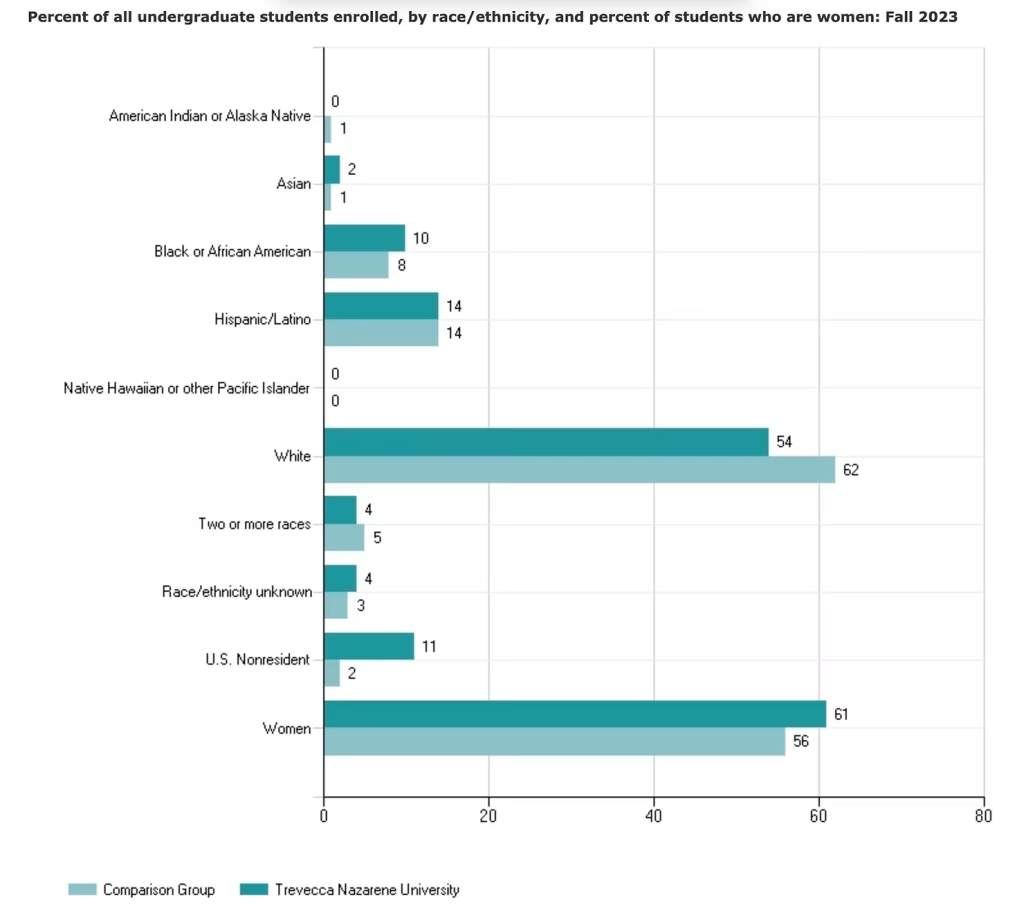
Compared to other Nazarene schools, Trevecca has higher non-citizen enrollment and a lower white student undergraduate enrollment. According to fall 2023 data from the National Center for Education Statistics, 54% of Trevecca undergraduates were white, compared to 62% across other Nazarene universities. Additionally, Trevecca’s U.S. Non-Resident enrollment stood at 11%—9% higher than the Nazarene university average nationwide. After Point Loma Nazarene University and Southern Nazarene University, Trevecca is the third most diverse Nazarene university in the country.
Schofield states that through Trevecca’s efforts with diversity and minority students, the university is fulfilling the Great Commission.
“I believe that Trevecca has really got a great intentionality about [serving its students]. Our cost is very low, and it’s a good environment [for] a good education. That’s why I think the school’s position on being an inclusive community, living out to provide as much education for leadership and service to as many people as we can,” said Schofield.
The university’s president, Dan Boone, had a friendship and connection with the founder of Equal Chance for Education, a non-profit organization focused on giving undocumented students an opportunity and financial resources to get a degree regardless of their immigration status.
Michael Spalding, the founder of the ECE, made it his life’s mission to support children missing out on financial aid, scholarships, and bank loans to pay for college, according to Spalding’s obituary in The Tennessean. The ECE was founded in 2014 and has provided more than 500 Tennessee students with scholarships to attend college. According to a TrevEchoes article from February of 2025, the ECE offers students up to a $25,000 scholarship to attend one of 15 universities that partners with the organization.
“Mike was a dear brother in Christ who came alongside me right at the beginning of our service to DACA students. And Mike had had a similar experience to one that I had had. He said, ‘I want to help you’,” said Dan Boone, university president, at a chapel service on Feb. 20. “For years, Mike Spalding wrote checks that would total $400,000 to $500,000 every year to help a group of students who would not have been able to afford college had it not been him. We gave him an office here on this campus. He was a retired physician, significantly wealthy. He could spend his money on himself in any way he wanted to, but he spent his money and time coming to this campus to sit in a room and have the students that he was sponsoring come and talk with them, mentor them, and care for them.”
Throughout Trevecca’s efforts to accommodate an increasingly diverse student body, the position of student director for inclusion and belonging was created in 2021. This position gave minority students a space to be represented in Trevecca’s student government association.
Melissa Colorado Origua, the current Director of Inclusion and Belonging for Trevecca’s SGA cabinet, emphasizes the importance of trust in her role as a student leader, but also acknowledges the weight of the position in times of political turmoil.
“The challenge now is going to be how do we ensure that our students still feel safe enough to keep that [trust] relationship going? A lot of people are scared. I wake up in the morning and see the news and I’m like, ‘Oh my gosh, what’s next?’ And it feels like sometimes the world’s on fire and like there’s no way we’re gonna catch a break,” said Colorado Origua. “But, how do we keep supporting our students and reassuring them that, from what we can do, we’re going to try to protect them as much as we can.”
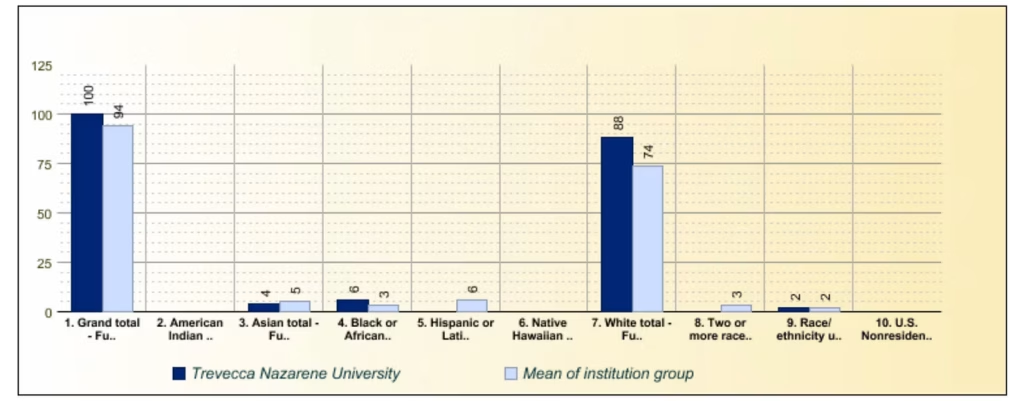
Although Trevecca’s student body is racially and culturally diverse, the current faculty does not reflect the diversity presented in the student body.
“We see it in faculty and staff. Sure, yes, student demographics are vastly different. But if you were to look up the demographics of ethnic and
“We see it in faculty and staff. Sure, yes, student demographics are vastly different. But if you were to look up the demographics of ethnic and racial [in faculty and staff], the stats are astounding,” said Justin Jose, director for leadership and community engagement. “They probably haven’t changed much in terms of, like, who Trevecca was 11 years ago. While we have this huge shift with student demographics, we don’t see that reflected [in the staff]. I would say that’s reflective of larger Christian higher ed.”
According to fall 2023 data from the National Center for Education Statistics, at Trevecca, 88% of faculty was white, with 6% African American and 4% Asian.
As a student and a hispanic woman, Colorado Origua appreciates the efforts that Trevecca has done to accommodate the increasing diversity in the student body, but feels like more could be done.
“One of the main reasons why Trevecca grew so much is because it’s cheap and it is good quality education at the end of the day. But also, I don’t really see much faculty that looks like me. I wish I could see that, but I also understand that is another issue with, like, hiring people,” said Colorado Origua.
Schofield’s initiatives, like faculty intercultural fellows, have been supported by both President Dan Boone and Vice President Tom Middendorf.
“We developed faculty intercultural fellows, which are departmental people with all the departments of the university. And what we do is we go to actually do the Intercultural Initiatives in each department,” said Schofield. “We let them set annual goals that in their pedagogy and outside of their classrooms, develop and do intercultural things to make people feel like they belong and that they care and that, you know, this is a community.”
Boone and Middendorf have added the department of mission, excellence and reconciliation as a part of the university’s strategic plan, according to Schofield.
“They’ve entrusted the faculty that I can train them and the students. Dan’s even got up and said, ‘Here’s the initiative, here’s what we care about. We’re intercultural’,” said Schofield. “The university has [given me support]. They’re giving me people who are in high positions that have a lot to say about what this university is, and I lead them in this initiative, and they go back into departments to make a change.”
Discover more from TrevEchoes Online
Subscribe to get the latest posts sent to your email.