
By Alayna Simons
Senior Reporter

Closed sign on the front doors of the Dollar General on Murfreesboro Pike. Alayna Simons / TrevEchoes
On Dec. 6, 2024, just two and a half weeks before Christmas, the Dollar General on Lafayette St. in Nashville, Tennessee, permanently closed.
For some, this may just be another building closing, but for the 6,000 to 7,000 who live in the Napier and Sudekum low-income housing community, this was a major loss due to the lack of resources in the area.
“To see it now where we don’t have that part of our community, the barriers and how hard it is for people to have access to something that is a basic human need is just so hurtful, painful, and disheartening,” said Amanda Key, co-chair of the health and wellness committee for the Love Thy Neighborhood Collective.
Key encourages others to change their language surrounding the Napier Sudekum area, referring to it as a “food apartheid” rather than a “food desert.”
Though the term “food apartheid” is not an official federal designation, as it was created by activists such as Karen Washington and others, who were searching for the root cause of food insecurity, leading to it now being a more popularly-used term than “food desert,” according to an article from Sentient Food.
“We are not a food desert because a desert is a natural habitat,” said Key. “We are definitely a food apartheid because we were a place where we had sustainable food, and those things were taken. Every resource that had to deal with food, human rights, and day to day, outside of the clinic and the library, has been taken from the major community, and it is just such a disservice.”
A food apartheid, according to Project Regeneration, is “a system of segregation that divides those with access to an abundance of nutritious food and those who have been denied that access due to systemic injustice.”
According to Medical News Today, in order to qualify as a food apartheid in urban areas, “at least 500 people or 33% of the population must live more than 1 mile from the nearest large grocery store” and in rural areas, “at least 500 people or 33% of the population must live more than 10 miles from the nearest large grocery store.”
“We need to be better neighbors,” said Key. “We need to hold, create, and maintain sustainability with authentic relationships, and people need to be educated.”Not only did the community suffer from a deeper lack of access to food as a result, but residents who were employed by that Dollar General location lost a stable income from the abrupt and unwarned closure.
“The only point of access for most people just left,” said Crys Riles, an anti-hunger advocate at the Tennessee Justice Center.
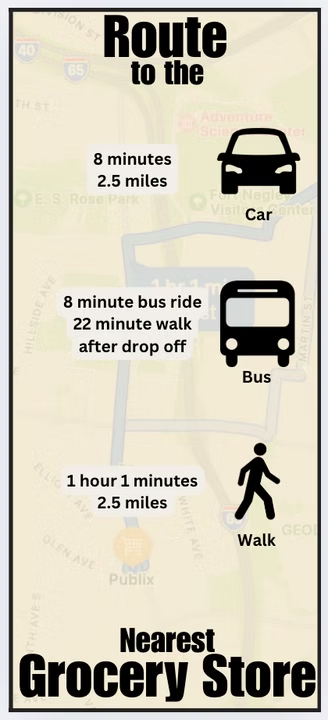
The nearest grocery store is just over two miles away, but with residents of this community without access to a car, the travel can be taxing.

“Even if it’s easy, in theory, to just get on the bus and go to the grocery store and come back, what happens if you have children, or you’ve got three or four children? What if you’re in a wheelchair or you’re unable to carry all of those groceries on your own because you have to walk?” said Riles. “It’s much bigger than just the food.”
Along with the closure, this year congress has attempted to pass yet another bill restricting the access of certain foods with Supplemental Nutrition Assistance Program (SNAP), which include soft drinks, ice cream, candy, and other desserts, pushing the number of attempts to pass this bill over 20.
According to the USDA Food and Nutrition Service, “SNAP provides food and benefits to low-income families to supplement their grocery budget so they can afford nutritious food essential to health and well-being.”
Though the decision to move forward with this bill has been tabled, the frustration of underlying injustice is prevalent in the community. If you remove choices completely, you remove the dignity of choice and control from the people, in turn enacting a form of oppression against them, said Riles, who grew up with his family using SNAP and continued to use it into adulthood.
“Food justice is allowing individuals and communities the right to the benefits and responsibilities of the food system,” said Riles. “To make their own choices, but allowing people to create systems that benefit them, and giving them the power to change them and to have responsibilities.”
According to a News Channel 5 article written in December 2024, though Dollar General did not give an explicit explanation, consistent theft and violence is believed to have led to its closure.
“There’s responsibility everywhere. There is no one side to this,” said Key. “I don’t think they respected the community enough to do it the right way. However, on the other side of this, the community did not rally itself together to make sure that the store was protected and respected and that it could keep its doors open.”
Local non-profits have rallied together over time to create “band-aids” for the situation, according to Key, such as personal rides to the grocery stores and pop-up farmers markets within the Napier community, but the ultimate goal is to open up a new grocery store with fresh and nutritional produce.
“The problem is, is that I feel like sometimes we get really focused on one piece of a solution and forget that sustainability is important,” said Riles. “So my hope is that we get to a place where everything that we do as a society is focused on improving the life of an individual and not just creating some gaps.”
Terri Neville, co-founder of the Love Thy Neighborhood Collective, spoke on the cycle of heartbreak that has passed through generations within residents of this community, making the line blurry between desperation and hope.
“Hunger has got to be on the top list when it comes to chronic trauma, and so people do desperate things when it comes to food,” said Neville. “I think everybody’s hope and dream is that they never go to bed hungry, that their kids have enough to eat. But even beyond that, it’s been interesting trying to find out what’s important from the neighbors. I’d really love to be able to connect the people in the neighborhood with their hopes and dreams and then we can empower that alongside them.”
Discover more from TrevEchoes Online
Subscribe to get the latest posts sent to your email.